
Duskpunk is a revolutionary inspiration worth playing
My favorite moments playing a tabletop role-playing game are those microseconds after the dice leave your hand, but before they land. In those moments, all your plans, your hopes, your character motivations, and the fractal possibilities of what can come next hang in the balance. This one success or failure on a speech check could change the entire tenor of this encounter: sneak through unscathed, or violence erupts and blows the plan. The best game masters can pivot on any point, and the best RPGs give them the tools to fail forward, building a rickety house of cards from half-successes and failures. At any point, it could all come tumbling down. And Duskpunk is both one of the best game masters and a game built on a rock-solid system that had me feeling that tension every moment.
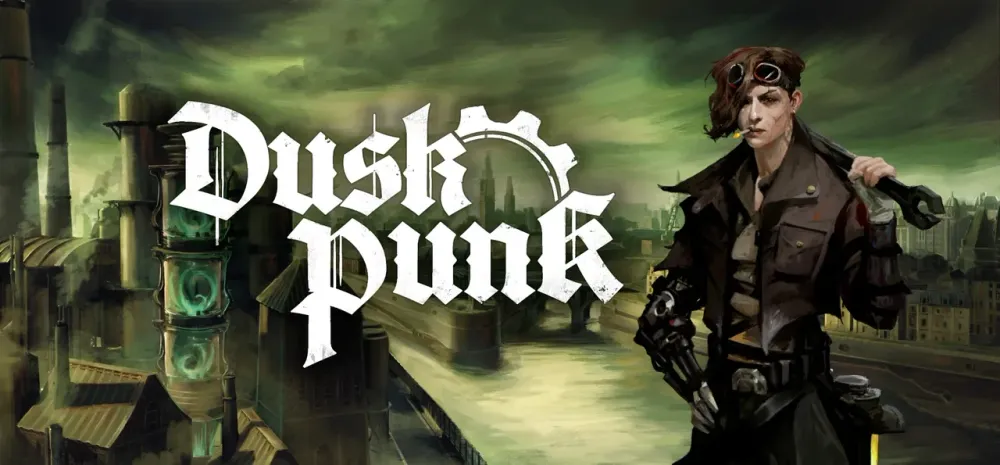
Duskpunk is a narrative RPG—a visual novel that incorporates dice rolls and skill checks—in the vein of Citizen Sleeper. You’ll begin the game selecting a character class with a series of pre-determined skills that you’ll rely on to complete tasks as well as upgrade throughout the game. Upgrade points are tied to game milestones and hard-won, so every point counts. You’ll go from an aimless veteran to a revolutionary leader in the course of ten hours, every step as stressful and exhilarating as the last, but you’ll rarely feel safe.
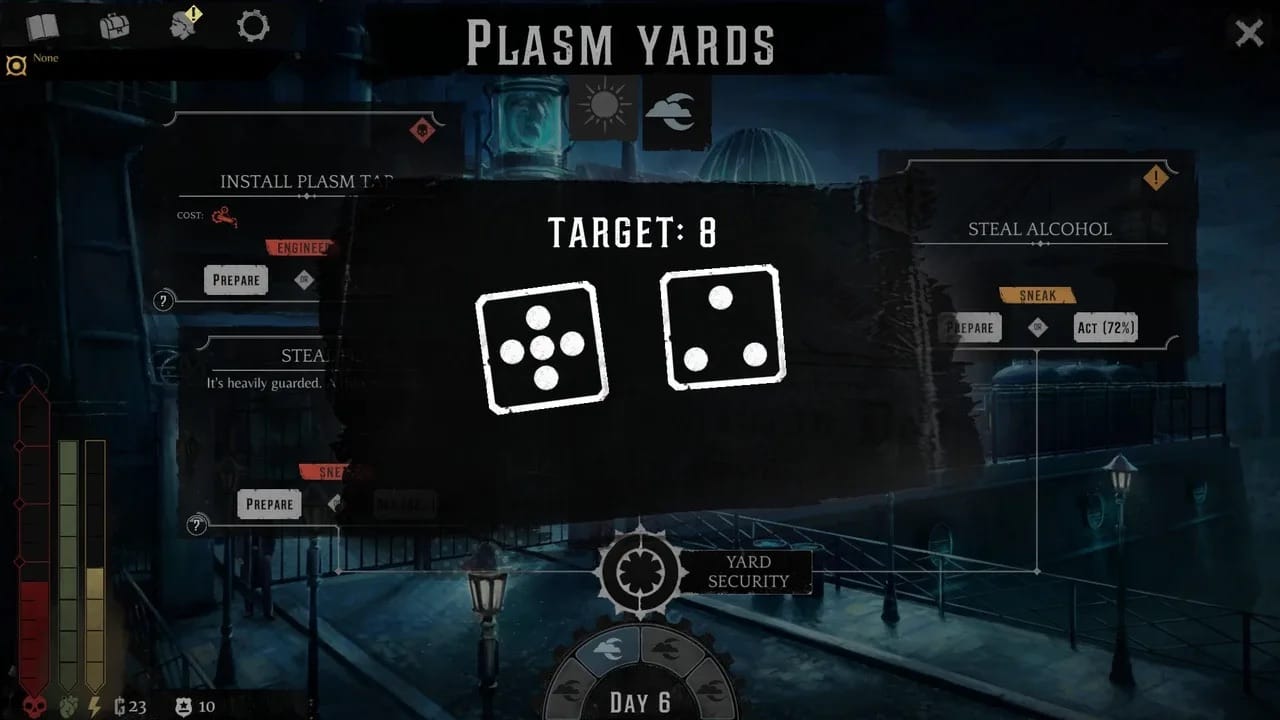
To do anything in Duskpunk, you’ll roll two six-sided dice, then add your skill number to see if you fail, half-succeed, or fully succeed. Unlike Citizen Sleeper’s dice pool mechanic (where dice are rolled at the start of the day and it’s up to you to slot them in), you can’t dump your best die into the task you want to complete; it’s all random. Most choices have little consequence beyond the time lost, but dangerous decisions will have negative consequences on a failure (such as health or stress damage), and deadly ones will have negative consequences on failures and partial successes.
To mitigate some of the risk, you can prepare actions, dedicating a segment of a day to reduce the skill check by two points. Especially early on, I found this mechanic to be a lifesaver, significantly increasing the odds of success. Later in the game, you’ll have new avenues to mitigate some risk, or at least more access to things that can reduce the consequences. However, the clock is always ticking, so preparing or relaxing at the club comes with its costs.
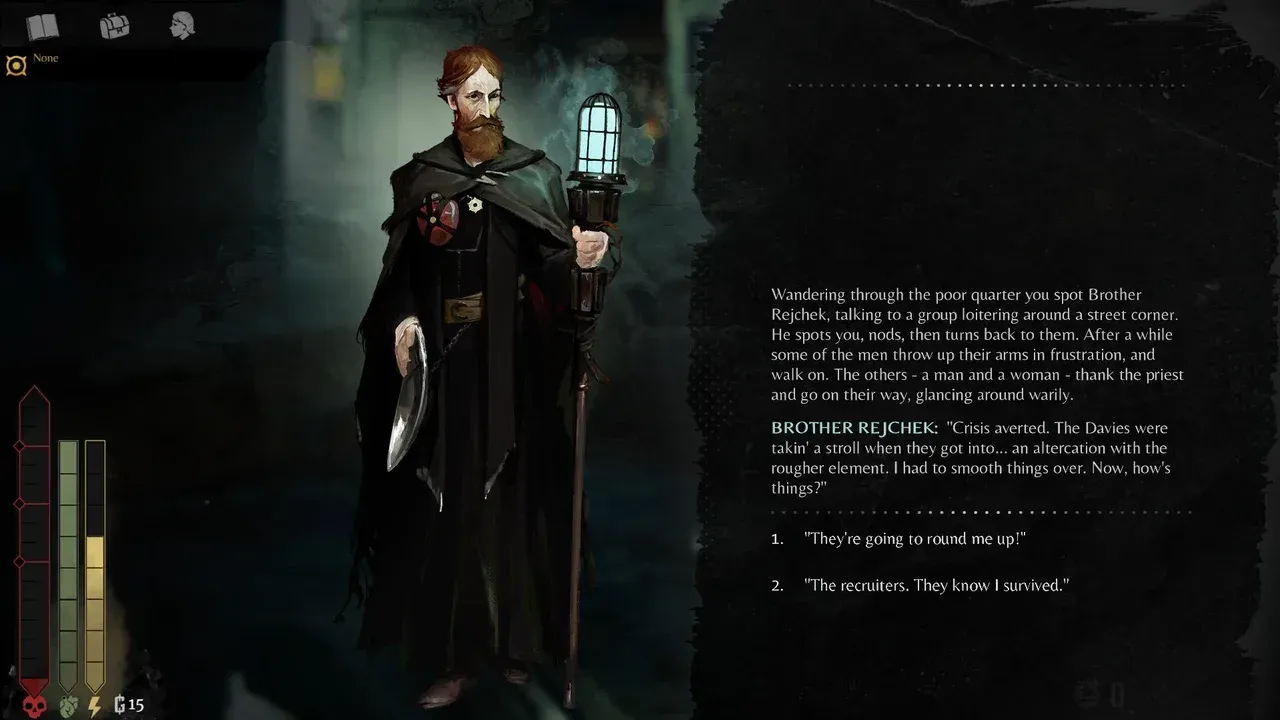
Your character, a veteran of the steampunk world’s equivalent of World War I, arrives in the city of Dredgeport on a Lichbarge, mistaken for dead and shipped back with the war dead to be turned into Plasm, a magical technology source siphoned from corpses. Penniless, unhoused, and racked with PTSD from your time on the front, you must survive on the rough streets…And the dice are merciless.
Everything is tightly limited in Duskpunk. Each day is divided into eight segments, with four in the daytime and four in the evening, with unique activities in each. You’re also constrained by three meters you’ll have to continually manage: stress, health, and energy. Energy begins with eight segments and ticks down three every time you sleep. You’ll need to scrounge for food, pay for it at a tavern, or find another method to keep your energy up because, if you don’t, you’ll take stress in the morning. The same goes for your health: failing an action may mean you get beaten up in an alley or that street fight you’re in to pay for food goes sideways, and you take a hit to the head. Keep your health up, or, you guessed it, your stress takes a hit.
Stress is the big meter you need to manage in Duskpunk, and not until much later in the game did I ever feel somewhat secure in my stress management. When your health or energy levels bottom out, you’ll take stress damage, but living in a city on the brink while evading the law is even more stressful. See something particularly grisly? Stress. Steal some Plasm from the refinery grinding dead bodies into fuel? Stress. Take a real bad roll and want to push your luck? Stress. Simply have a bad dream? Stress. Accumulate too much stress, and the ones on your two dice turn to zero, up to replacing the one, two, and three slots. In the early game, there is only one method of relieving stress: Solace, an injectable drug that loses its effectiveness as you use it.
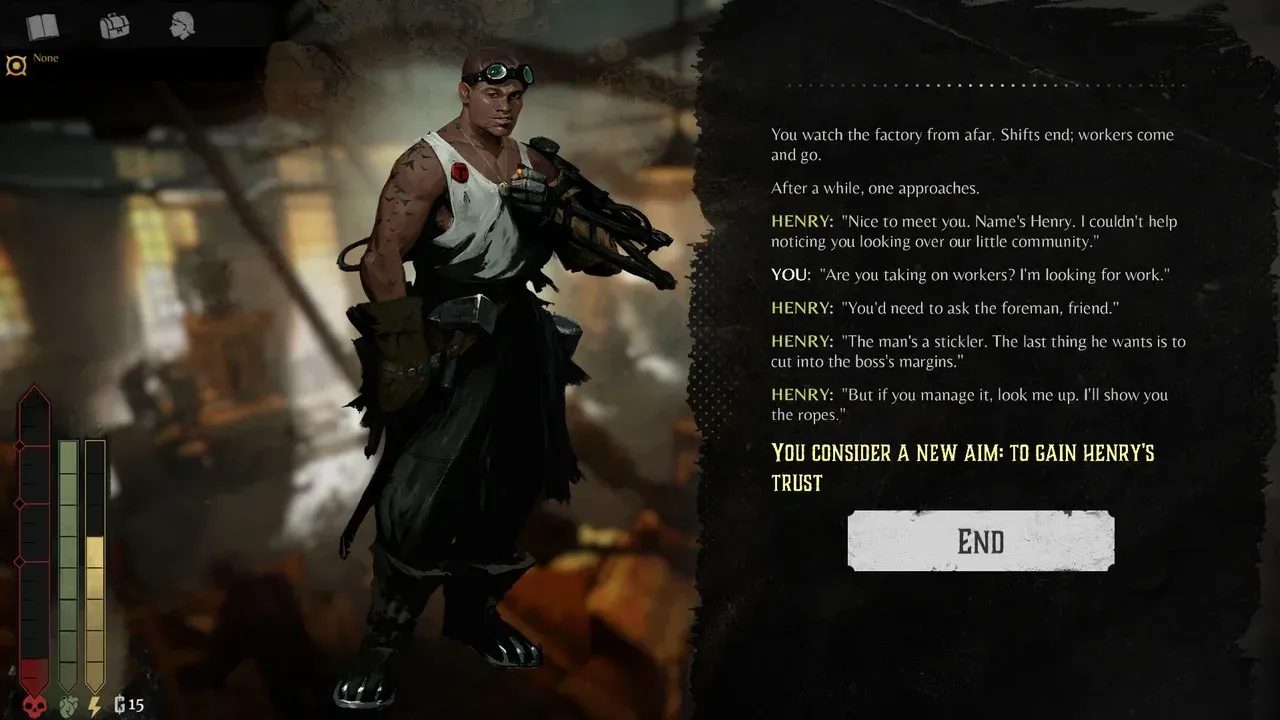
Those first few hours in the game are desperate. You’ll scrounge up a few coins from pickpocketing—risking hits to your health with every failed attempt—then spend them on a meal at the tavern, hopefully before your energy meter bottoms out, adds to your stress meter, and flips one of your skill dice to a zero. You’ll sleep in alleyways (sleep is also a skill check), then suffer from traumatic nightmares, adding further to your stress. All the while, the police are on the lookout for draft dodgers: a blaring red clock ticks up every time you sleep.
Much like Citizen Sleeper and Powered by the Apocalypse system tabletop games, Duskpunk uses “clocks” to let you know when a task will be complete or a countdown ends. You’ll spend time casing a dock warehouse to add progress to the “rob a warehouse” clock, or do everything you can to mitigate or avoid a red countdown clock, like “appear at the recruitment office.” A failed countdown clock isn’t game over, though; it’s just another wrinkle in your character’s story.
The last three things you will manage in Duskpunk are Groats (your currency), your Wanted level (are the Watch on your tail or not), and Solidarity. There’s an entire inventory of items that you can trade like currencies or use to complete game objectives (scrap can be turned into machine parts; rumors can be traded for tip-offs or blackmail, etc.), but which path you go down will end up being tied to your skills, most likely. In my playthrough, I played as an engineer, scrapping and building machine parts to trade to the Machinists for money.
If those mechanics sound in the least bit interesting to you, stop reading here and play the game. Duskpunk is one of those rare games that is somehow, inexplicably, about hope and solidarity when the world and the game itself want to crush it. It’s even more amazing that this year is bookended with Citizen Sleeper 2 and Duskpunk, two games that are currently vying for the same slot on my Game of the Year list.
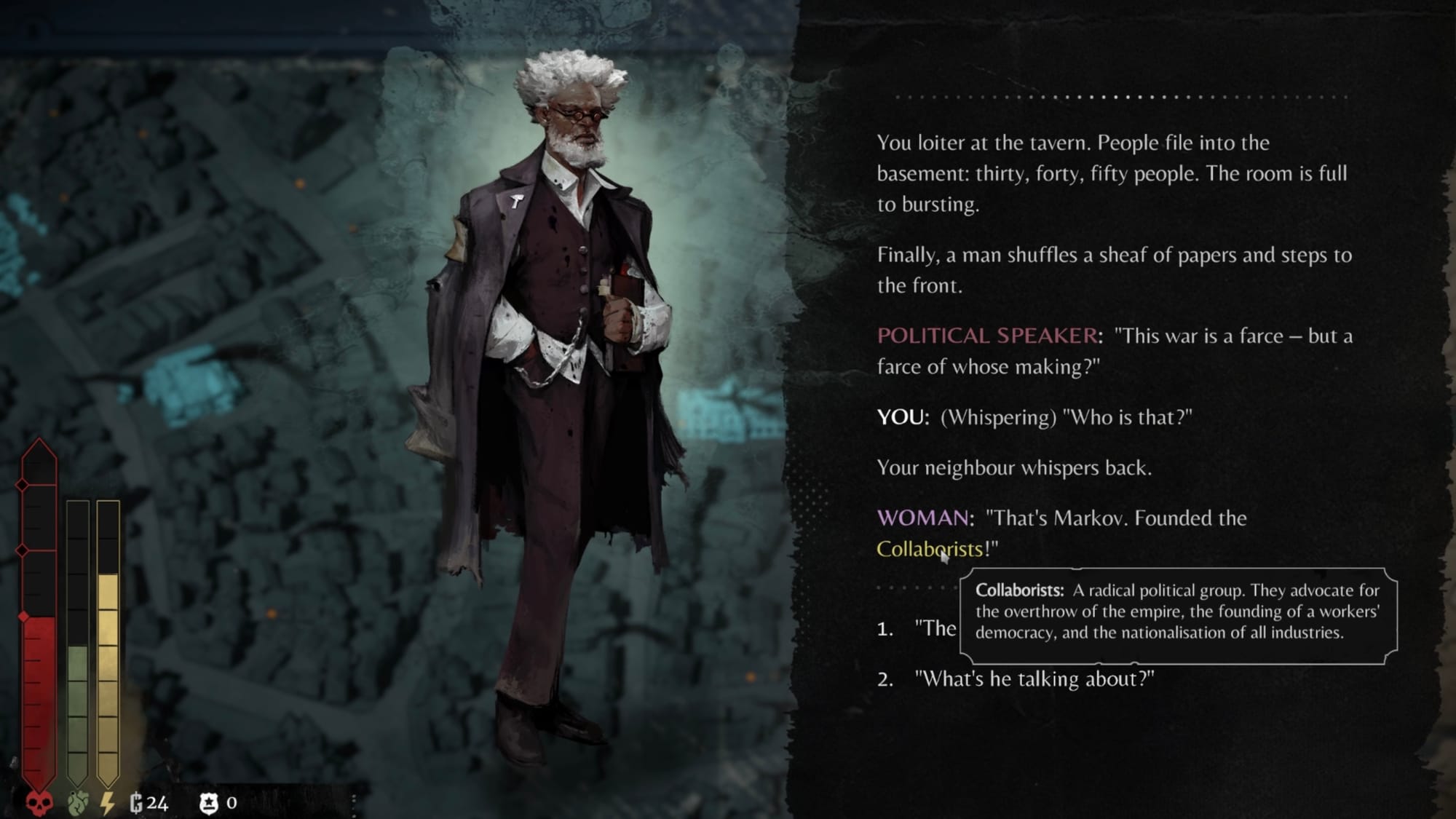
The story in Duskpunk is phenomenal. The writing is propulsive, dragging me through hours of “one more day and I’ll go to bed.” I was fully immersed in the world and fell in love with so many of the well-rendered characters. Duskpunk is, from the outset, a game about solidarity. You arrive in Dredgeport alone and penniless, but it’s only through the kindness of others and your character taking risks to stand up for the downtrodden that you will find a reprieve from all the horror. As the game progresses, each small interaction will begin to fold into the game’s main narrative: a revolution that could go one of a few different ways.
Your character can be tightly knit into the revolution to come: working for the people, the landed gentry, or the gangs. Across your multiple hours, you’ll complete quests for a handful of colorful, memorable characters that have their own apprehensions about collective action. My Engineer character was highly embedded with the Collaborists, Machinists, Deserters, and Factory Workers, with each faction having extensive quest paths that reward you with upgrade points and resource opportunities.
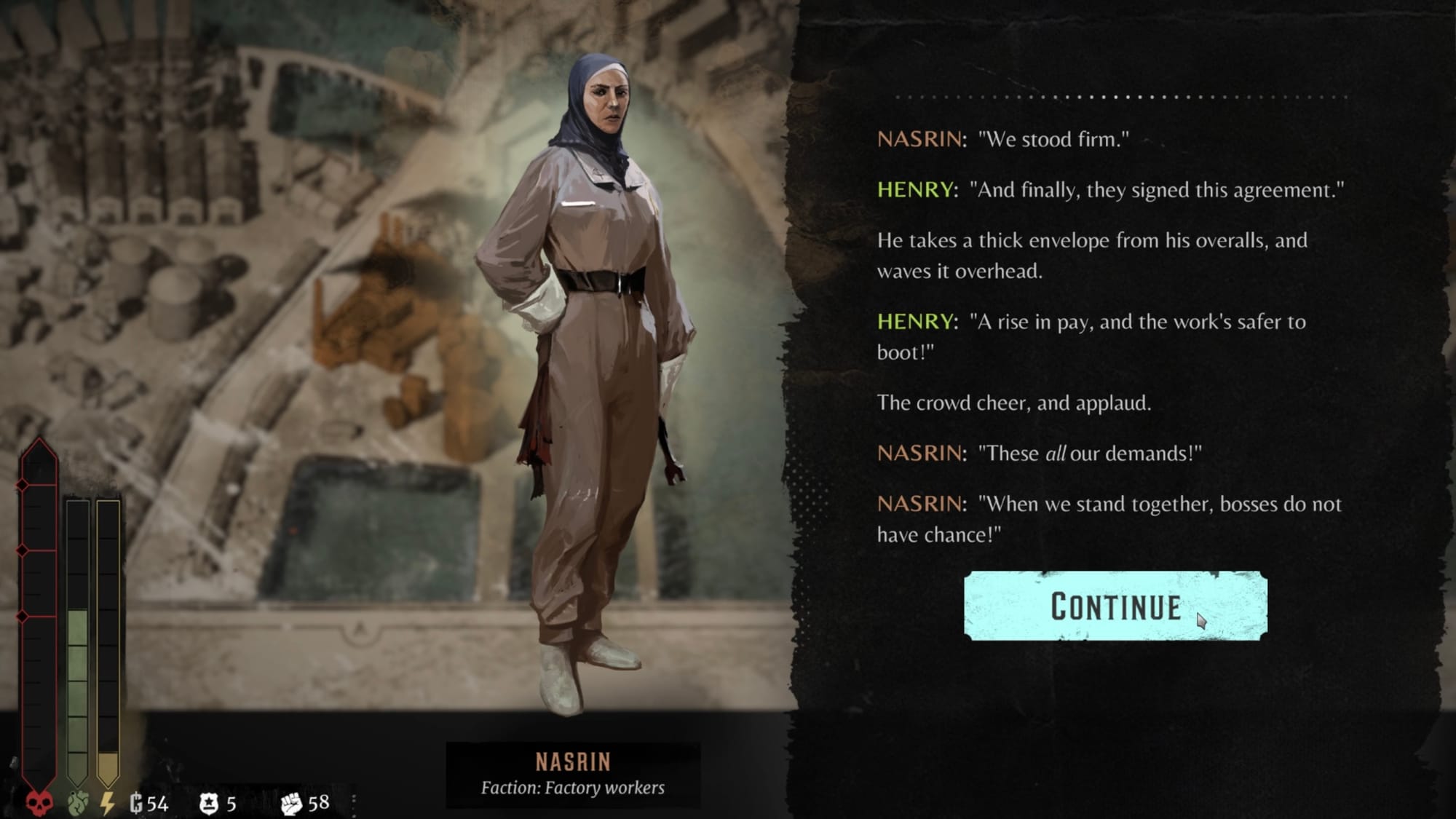
There is a lot going on in Duskpunk, but if I could nail down one central theme, it is that abundance comes from assistance. Duskpunk is deeply interested in the solidarity that arises from disparate people and the strength that comes from uniting them. That strength is personal and societal as well; each faction you unify, progress, and connect with other factions, will provide more opportunities to manage your health, stress, or energy. Each connection breaks down the status quo: a People’s Assembly of all manufacturing unions is a revolutionary act that builds Solidarity, the final currency you collect in the game.
If you play your cards right, distribute pamphlets, march with the people, encourage solidarity and connectedness, and engage with the rebellious aspects of the game, you’ll be rewarded with Solidarity, a nebulous currency you’ll use in the game’s conclusion. Some of my favorite moments in Duskpunk are being able to skip deadly actions and spend my Solidarity instead. You’ve spent hours building the connection and apparatus to take down this awful regime, so being rewarded for that hard, costly work in the end is a perfect payoff. Pulling from another tabletop game, using Solidarity often feels like the flashback mechanic in Dusk City Outlaws; storming the Imperial Palace is so easy because you trained your troops previously, a choice that takes no time and only costs Solidarity in the moment.
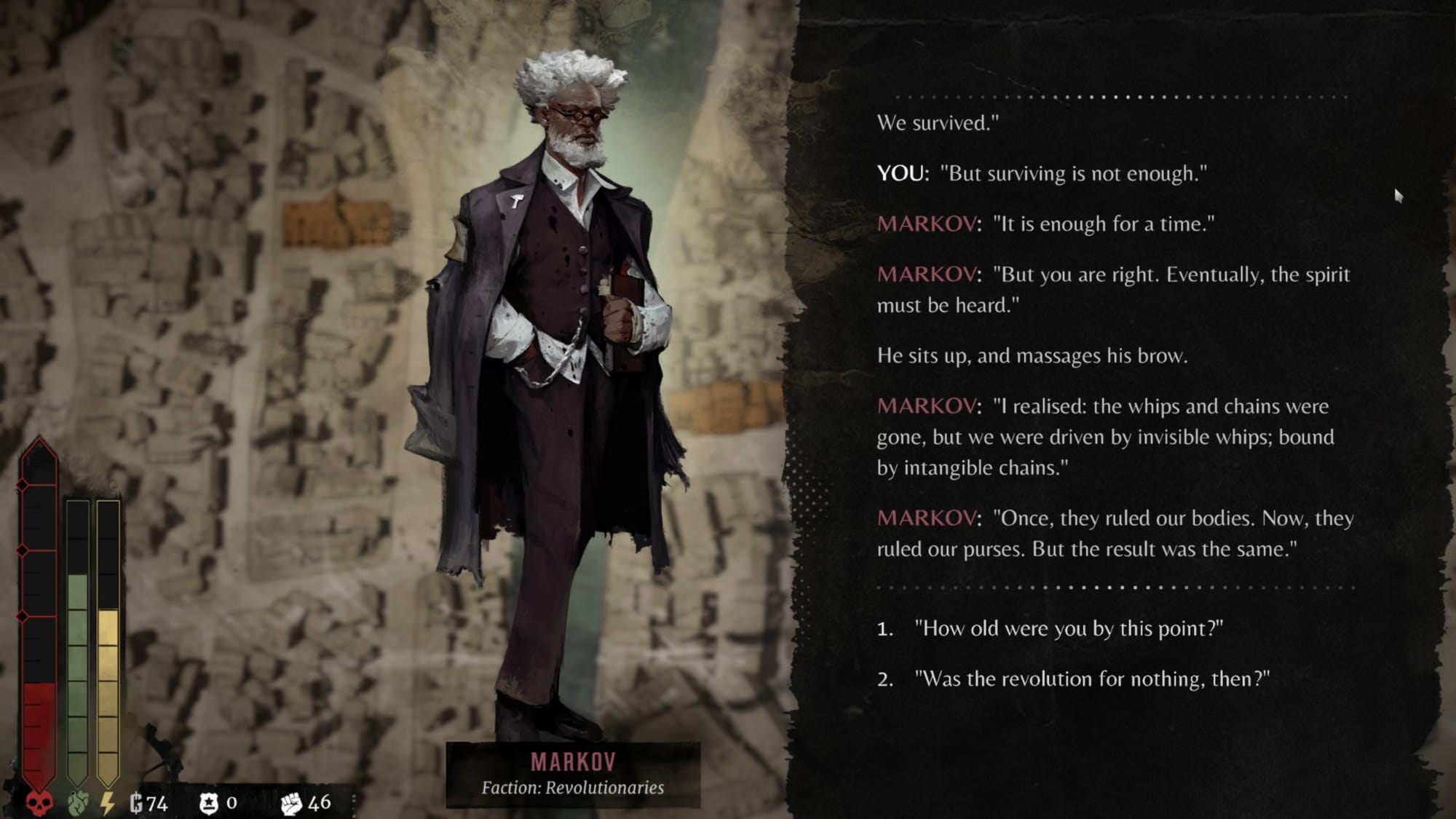
The Solidarity mechanic and what Duskpunk has to say about abundance (in opportunity and dollars) is what makes this game so interesting to me. As I mentioned earlier, my Engineer character had an aptitude for scrapping and making machine parts for money, an opportunity I only unlocked by befriending the Machinists. Selling those parts became an easy way to make money, so when I planned to frame the Lich Dealers gang and free the docks, I used that money to hoard Solace, the stress-relieving drug. I ended the game with five Solace, but something surprising happened in the latter half of the game: I never used the drug. As my housing opportunities increased in quality, I was rarely wracked with awful nightmares; as my pocketbook increased, I never went hungry; as I completed more connections with factions and gained upgrade points, I stopped failing most skill checks.
Duskpunk, open to close, is a story about the stresses of money and how those stresses can very quickly evaporate with a surplus of cash and solidarity. The game is explicit, though: you need both. The game gets easier as the choices get weightier, not because you’re better at the game, but because you are supported by those around you, just as you support them. Solidarity is a two-way street and some of the best moments (the beggars coming to aid the union workers; the Deserters overwhelming a machine gun nest at a protest) of Duskpunk come from the connections between disparate groups.
There are tensions in revolution—there always will be—but the messiness of the game’s conclusion can be left up to a dice roll, everything hanging in the balance, or achieved through Solidarity. And if that’s not a message hyper-relevant to our current times, I don’t know what is. Duskpunk should be a required game; its revolutionary politics—both from theory to practice—is an inspiration for me in these dark times, and I suspect it will be for you too.